AI drone-routing research connects battery reserves, charging and mission time. Examine original route comparisons and a practical evaluation approach.
Select a figure to open it at full size.
For a drone fleet, the shortest route is not necessarily the fastest mission. A vehicle that takes a cheap-looking detour may return to charge more often. A route that looks efficient on a map may leave too little battery to get home. The planning problem connects the next destination, the battery reserve and the time spent replenishing it.
Kaiwen Li and colleagues investigate that interaction in research on reinforcement learning for UAV routing with wireless charging. Their system learns to choose the next location while tracking the aircraft’s remaining energy. It is a simulation study of routing and charging, with useful implications for delivery planning; it does not demonstrate a package-delivery service or airborne charging hardware.
This revision replaces the earlier article’s model-predictive-control comparison with a source whose routing method and evaluation can be examined directly.
The researchers minimize total mission time: flight time plus charging time. The drone must visit the required locations and return to its base, potentially returning for energy several times along the way. The model therefore has to choose a sequence of trips, rather than draw one uninterrupted tour.
An encoder first turns the locations into numerical representations. An attention-based decoder chooses the next location using that map, the previous location and the current state of charge. Before selecting an action, the system masks choices that violate its constraints. A location is unavailable when visiting it would leave insufficient energy to return to base with the specified 20% reserve. Already visited locations are also excluded.
Those rules matter as much as the learned preferences. Training can teach a policy which feasible move tends to lead to a shorter mission. The mask prevents it from buying a better score by making a prohibited move. When it returns to base, the drone charges and resumes the remaining visits.
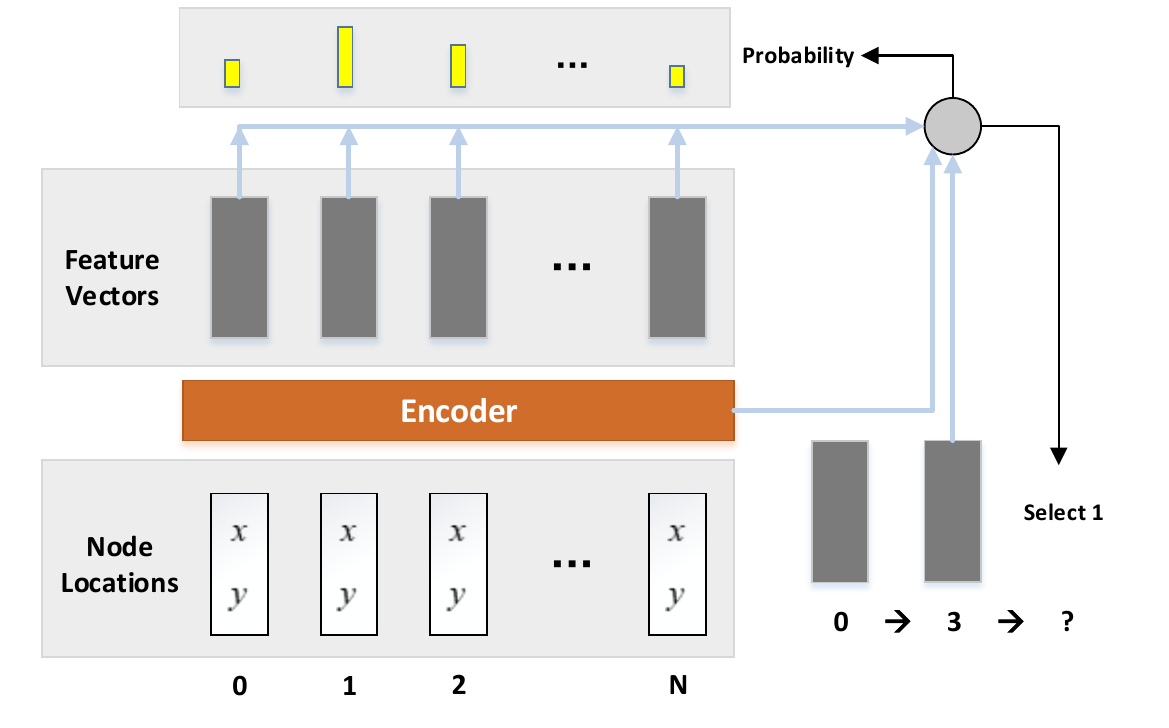
The model is trained offline, so the expensive learning process happens before a new route is requested. At planning time, it can make one sequence of choices quickly or spend longer considering several candidates. That gives an operator a practical tradeoff between response time and route quality.
The evaluation generates routing instances with different numbers of locations. For each size, the authors test 100 instances and compare their learned policy with an operations-research baseline. Flight speed is fixed at 10 metres per second, and the simulator supplies the energy and charging assumptions. Mission time is measured in hours; computation time is measured separately in seconds.
In the 50-location test, beam search produces an average mission of 3.050 hours, compared with 3.072 hours for the OR baseline. Reported computation times are 0.056 and 0.374 seconds respectively. The mission improvement is modest; the route is produced faster under the experiment’s conditions.
The 100-location comparison is more revealing. Sampling candidate routes produces a 3.928-hour mission in 0.304 seconds. The OR baseline finds a slightly shorter 3.900-hour mission but takes 1.71 seconds. The learned approach offers a different operating point, not an unqualified win on both objectives.
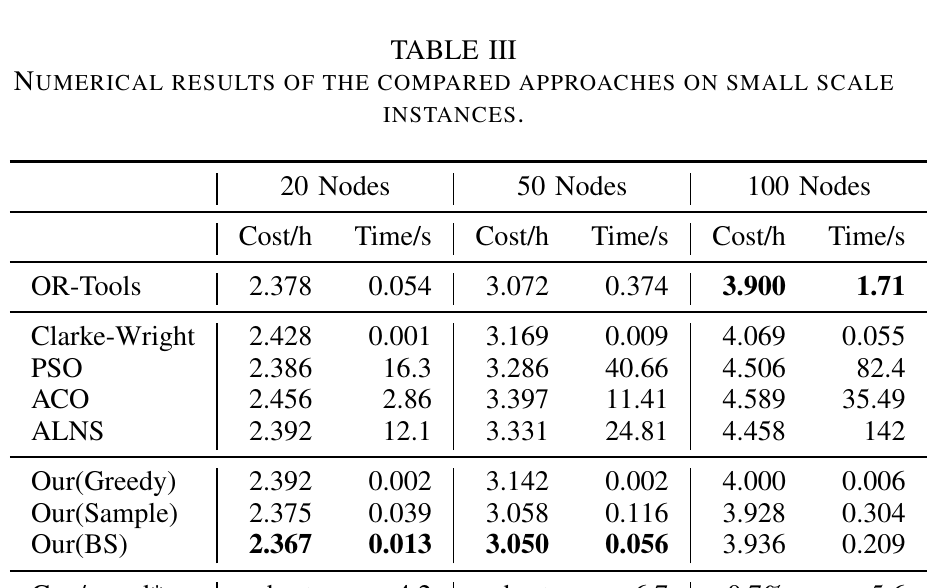
The search budget also matters. A greedy policy follows its preferred choice at each step. Beam search retains several promising partial routes, while sampling generates many complete candidates and keeps a good one. The paper uses up to 1,280 sampled candidates or a beam width of 1,000. These are materially different amounts of planning work, even though they share a trained model.
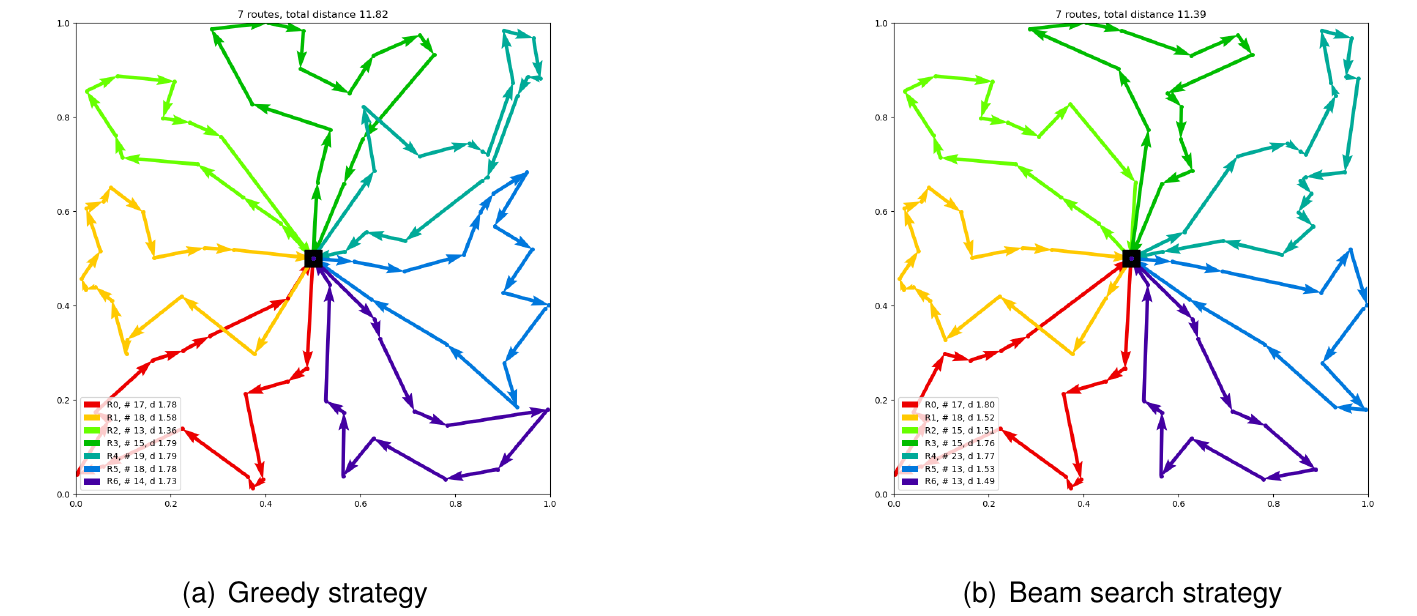
The original route comparison makes that distinction visible. On the same 100-location instance, the greedy and beam-search versions choose different sequences and base returns. The beam-search route avoids some of the inefficient crossings in the greedy route. The picture helps explain how a better sequence emerges; a single diagram cannot establish an average fleet saving.
The larger tests show why completion rates belong beside averages. At 150 locations, the OR baseline solves 69 of the 100 instances within the limit, while the sampling method solves all 100. Averages over those different sets are not a clean like-for-like speed comparison. Failure to solve within one experiment’s time budget also does not establish that conventional optimization cannot handle the problem.
The physical assumptions are another boundary. Wireless power transfer is represented by a mathematical charging model. The study does not validate a safe, economical charging installation or flight performance under wind, changing payloads and restricted airspace. Those factors could change which routes are feasible and which are attractive.
For delivery teams, the transferable idea is battery-aware decision-making with an explicit reserve. The reported hours and runtimes are evidence about this simulator, not a delivery promise.
A useful first trial would take historical missions and ask two planners to route the same jobs with the same battery, charging and operating constraints. Keep the existing planner as the baseline. Add the actual payload-dependent energy model, charging locations, service times and restrictions before comparing results.
Record mission completion, reserve violations, total mission time and planning latency separately. Include difficult cases: a long final leg, an unavailable charger, an energy estimate that was too optimistic, and an urgent new request. A policy that produces shorter nominal routes but fails those cases has not improved the operation.
Start with suggested routes reviewed by an operator. Consider further integration only when the learned approach preserves feasibility and improves a metric that matters at the required response time. The same distinction between route distance and operational objectives applies to AI logistics planning.
OR-Tools’ capacitated-routing tools provide a useful conventional baseline for constrained routing. Vehicle capacity is supported directly; the paper’s battery consumption, reserve and charging-time behavior still need explicit modeling. A capacity example alone does not reproduce this experiment.
Build a small simulator with the existing operation’s constraints first. Verify that its feasibility checks reject known impossible missions. Then compare a learned policy and the baseline through that same simulator, using identical instances and a declared computation budget. Keep training cost separate from planning latency, and log both failed instances and successful routes. No model training or flight trial was performed for this article.
A learned routing policy is most interesting when plans must be produced repeatedly under a tight time budget and the operating environment is stable enough to model. This paper shows a credible computational approach to that problem, with a meaningful battery constraint and an explicit quality-versus-speed tradeoff.
It does not justify replacing a flight-control or safety system. The adoption case depends on whether the route advantage survives a realistic energy model, operational disruptions and a fair conventional baseline.
Kaiwen Li, Tao Zhang, Rui Wang and Ling Wang, Deep Reinforcement Learning for Online Routing of Unmanned Aerial Vehicles with Wireless Power Transfer, arXiv version 1, April 25, 2022.
Separate language-based mission planning from perception, navigation and flight control.
Connect shorter planned routes to the operational measurements needed for sustainability.