How E2ETune learns database settings, why it reduces tuning time, and when its training costs make sense for a PostgreSQL fleet.
Figures open at full size. Wide tables scroll sideways.
Database tuning has two costs: finding a configuration and living with the performance it delivers. A method can reduce the first without finding the absolute best answer to the second.
E2ETune is interesting because it moves much of the search effort offline. Instead of replaying a new workload through a long sequence of candidate settings, a fine-tuned language model proposes configurations and a separate performance model ranks them. The research reports large reductions in tuning time, while also showing the preparation needed to make that shortcut work.
For a platform team managing many similar database environments, that trade could be worthwhile. For one database that rarely changes, training a specialized model may cost more effort than it saves.
Xinmei Huang and colleagues evaluate E2ETune on PostgreSQL 12.2, tuning 45 selected configuration parameters. The study covers ten analytical and transactional benchmarks, plus three workloads from real-world scenarios. Two of those additional workloads are tested in ByteDance’s internal development environments.
The method learns from examples pairing a workload with a promising configuration. It does not infer every database’s ideal settings from a generic chat prompt. Its inputs describe the workload, the database’s query plans and observed internal metrics. Its training data is produced through a substantial search-and-validation process.
The original architecture diagram separates that preparation from the later recommendation stage.
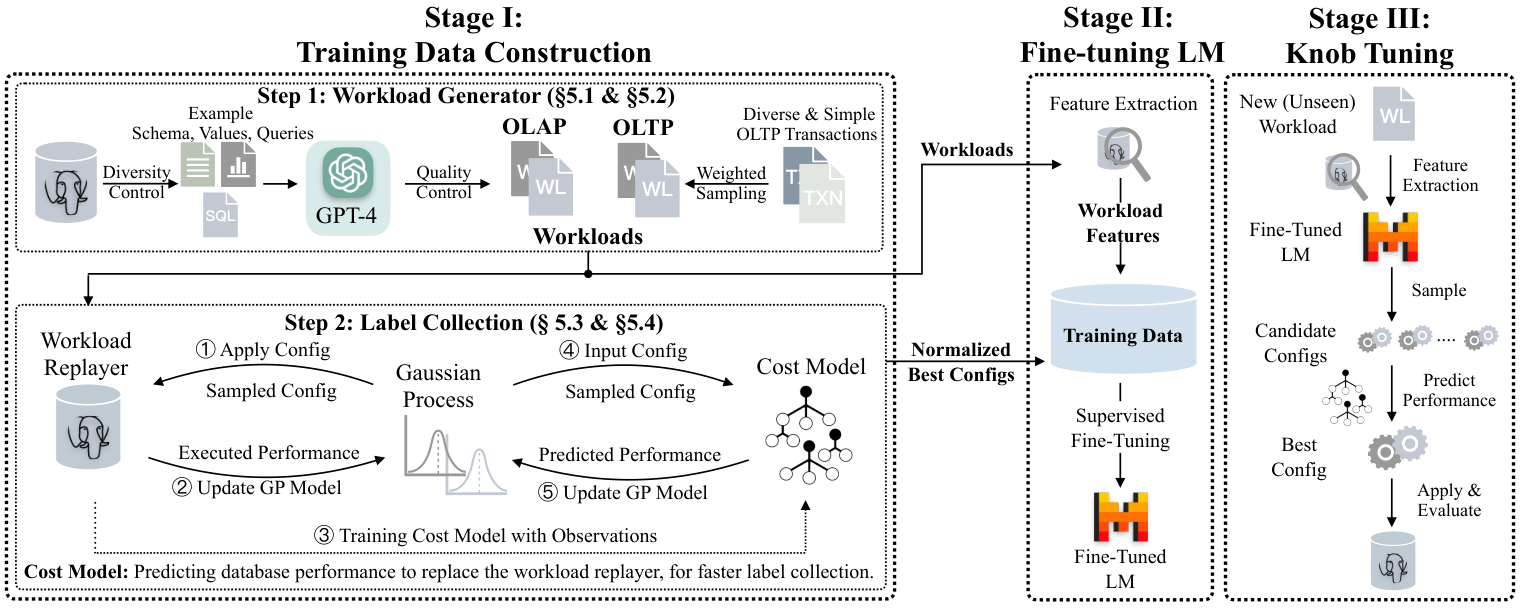
For analytical workloads, the researchers use GPT-4-Turbo to generate SQL from schema information, example queries and sampled column values. They check syntax using EXPLAIN, request repairs and discard persistent errors. They also run valid queries and exclude those exceeding a runtime threshold. For transactional workloads, they vary the mixture of predefined transaction types.
Next, the HEBO optimizer searches for useful configurations. Real workload executions supply observations for a cost model; that cost model then substitutes for many expensive executions during further label collection. Its job is to distinguish better and worse configurations for a workload, not to provide a universal estimate of elapsed time across unrelated workloads.
The authors still verify the final proposed training configurations by running the workload and checking that they improve on the default. That validation matters: a model trained on an optimizer’s predicted winners could otherwise learn the cost model’s mistakes.
After filtering, the language model receives 2,953 workload–configuration pairs. It is trained to map workload information to suitable settings. Query plans provide a structured description of operations and estimated costs; internal metrics add information about the workload’s observed behavior. Neither is equivalent to simply giving the model a database’s name.
Configuration values differ dramatically in scale. Rather than directly generate exact numbers for every parameter, E2ETune normalizes numerical ranges and divides them into ten buckets. The model selects a bucket; the system converts its midpoint back into the parameter’s allowed range.
The paper illustrates this with max_wal_senders. If the predicted bucket spans 30%–40% of the permitted range, the system uses its midpoint, 35%, to recover a numerical setting. The percentages are positions within a configured range, not a universal recommended value for that parameter.
At inference, E2ETune typically samples eight configurations and uses its cost model to choose among them. This is the distinctive sequence: generate several plausible candidates, then rank them using learned performance information. It avoids a long online search, but still depends on the quality of both models and their training environment.
The ablation study tests parts of that design. Removing input features weakens performance; removing query plans is particularly damaging in the cross-schema setting. Directly generating numerical values also performs worse than the bucket representation. Sampling and ranking adds a smaller improvement over greedy generation. Those results suggest that representing the problem well is at least as important as adding a language model.
On the in-schema TPC-H evaluation, the paper reports 19.8 minutes for E2ETune versus 1,381.7 minutes for HEBO. That comparison concerns the time required to tune a workload. It does not mean individual database queries run 98.6% faster.
The distinction is especially clear in the original results for StackOverflow, SSAG and AMPS. The red stars show E2ETune finding useful configurations early. Other approaches can eventually find configurations with a greater performance improvement.
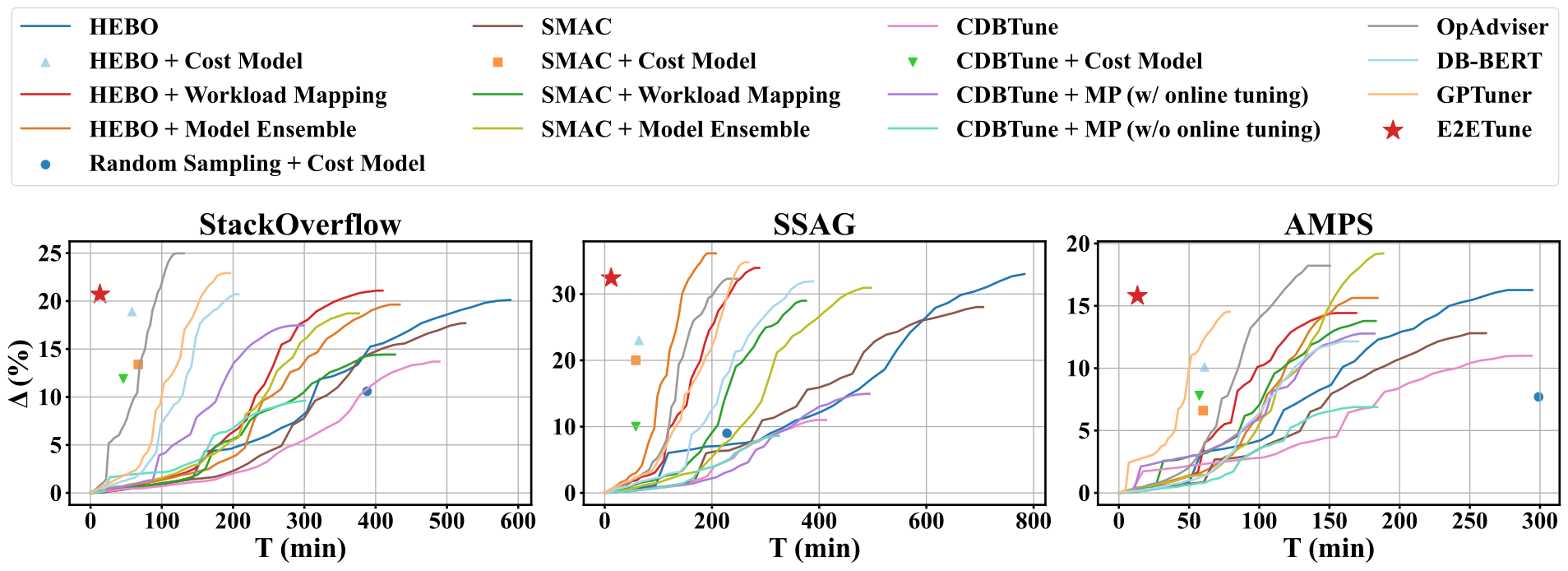
This is an attractive result when obtaining a good configuration quickly is the objective. It is a different proposition from guaranteeing the optimum. The paper itself reports that E2ETune does not produce the best configuration in these three real-world benchmark cases.
The online comparison does not erase offline costs. The paper reports approximately 30 days on a single machine for collecting the real-execution tuning observations and 40 days on a single machine for the cost-model-assisted label collection, with eight identical servers used in practice to accelerate the work. Fine-tuning takes about ten hours on the reported GPU setup.
Those are study-specific resource figures, not current cloud-price estimates. They establish the shape of the investment: pay to produce reusable tuning knowledge, then benefit across subsequent workloads.
The authors consequently identify stable or enumerable environments as a good fit. A fleet with consistent hardware and database products offers more reuse than a collection of unrelated engines. A new engine with different parameters requires new data and training. Even cross-schema results within the study should not be treated as proof of universal cross-engine transfer.
Begin with PostgreSQL’s own workload evidence. Its official EXPLAIN documentation describes how to inspect query plans, including machine-readable formats. Collect plans and representative workload statistics in an isolated environment. Estimated planner costs are not elapsed milliseconds, and EXPLAIN ANALYZE actually executes the statement; choose the appropriate command for the work being inspected.
Treat E2ETune as a specialized training-and-evaluation architecture. Reproducing it requires workload generation, measured configuration labels, a ranking model and language-model fine-tuning. Existing benchmark and tuning code may be sufficient to establish whether the potential benefit justifies that work. A generic assistant offering parameter suggestions is not an implementation of the paper.
For a pilot, choose one database version and hardware class. Compare generated configurations with the current DBA-approved configuration and a conventional tuning method on held-out workloads. Measure tuning effort separately from throughput, typical and tail latency, memory pressure and failed runs. The paper restarts its DBMS for each configuration because some parameters require it; account for that operational behavior when designing the experiment.
Keep a known-good configuration and a defined rollback procedure. Do not promote a recommendation merely because the cost model ranks it first. Verify it against the workload and constraints that matter to your service. Configuration tuning also cannot correct the meaning of a bad query; our AI-generated SQL analysis examines that separate problem.
E2ETune’s strongest argument is the reuse of expensive tuning experience. It makes sense to investigate when a team repeatedly solves related tuning problems and can maintain representative training data.
For an isolated database, first establish whether conventional measurement and tuning already solve the problem at lower total cost. For a standardized fleet, evaluate the amortized cost of preparation and the quality of held-out recommendations. The research supports faster access to useful configurations; it does not support instant, universal or risk-free optimization.
E2ETune: End-to-End Knob Tuning via Fine-tuned Generative Language Model, Xinmei Huang and colleagues, Renmin University of China and ByteDance. arXiv version 3, revised 19 March 2025. This article uses that version; the earlier version titled LLMTune describes a different iteration of the work.
Compare the cost of communication between stages with the parallelism lost by combining them.
Compare inference-routing decisions when the preferred accelerator is unavailable.