What world-model research proposes for adaptive AI: action consequences, learning from failure and a practical way to test predictions in a simulator.
Select a figure to open it at full size.
An AI system can produce a plausible plan without knowing what will happen when that plan meets the world. For a team building an agent, that gap matters more than whether the explanation sounds intelligent. Can the system anticipate the consequences of an action, notice when its expectations fail and update its behavior?
Javier Del Ser and colleagues explore that question through the idea of world models: internal representations that connect observations, actions and expected outcomes. Their paper draws on child development to propose a research agenda for more adaptive AI. It is a conceptual argument, not a report of a new system outperforming existing models.
The distinction makes the article useful in a different way. It provides questions for designing and testing an agent, rather than a benchmark score or a ready-to-deploy architecture.
The authors use two ideas from developmental psychology to explain learning. Assimilation means interpreting a new experience through an existing model. Accommodation means changing the model when that interpretation no longer works.
Their animal-category example makes the difference concrete. A child may initially associate a dog with features such as four legs and a familiar behavior. Encountering another animal can expose the limits of that category. Learning requires more than remembering the new example: the child may need to revise which features distinguish one kind of animal from another.
For AI, the proposed parallel is a system that maintains a model of its environment and revises it when observations contradict expectations. Merely adding another sentence to memory does not establish that the model’s behavior has changed. The useful test is whether it now predicts or chooses differently in the relevant situation.
The paper also emphasizes active interaction. A child dropping an object receives evidence about an action and its consequence. That is different from observing that two events often occur together. The AI research question is how a system can use such interactions to learn relationships that support useful predictions and decisions.
The authors organize development around perception, representation, reasoning and generalization. A system senses the environment, builds an internal account of it, uses that account to consider consequences, and applies what it has learned beyond the original situation.
This sequence is an analogy and design proposition. The paper does not demonstrate that reproducing developmental stages is necessary for intelligent behavior, or that one specific architecture implements them successfully.
Its research agenda brings together six areas. Physical and embodied learning connect action with the environment. Neurosymbolic methods combine learned patterns with structured representations. Causal reasoning concerns interventions and consequences. Open-world learning addresses unfamiliar situations. Human participation supports correction and oversight. Responsible design addresses how those capabilities should be constrained and evaluated.
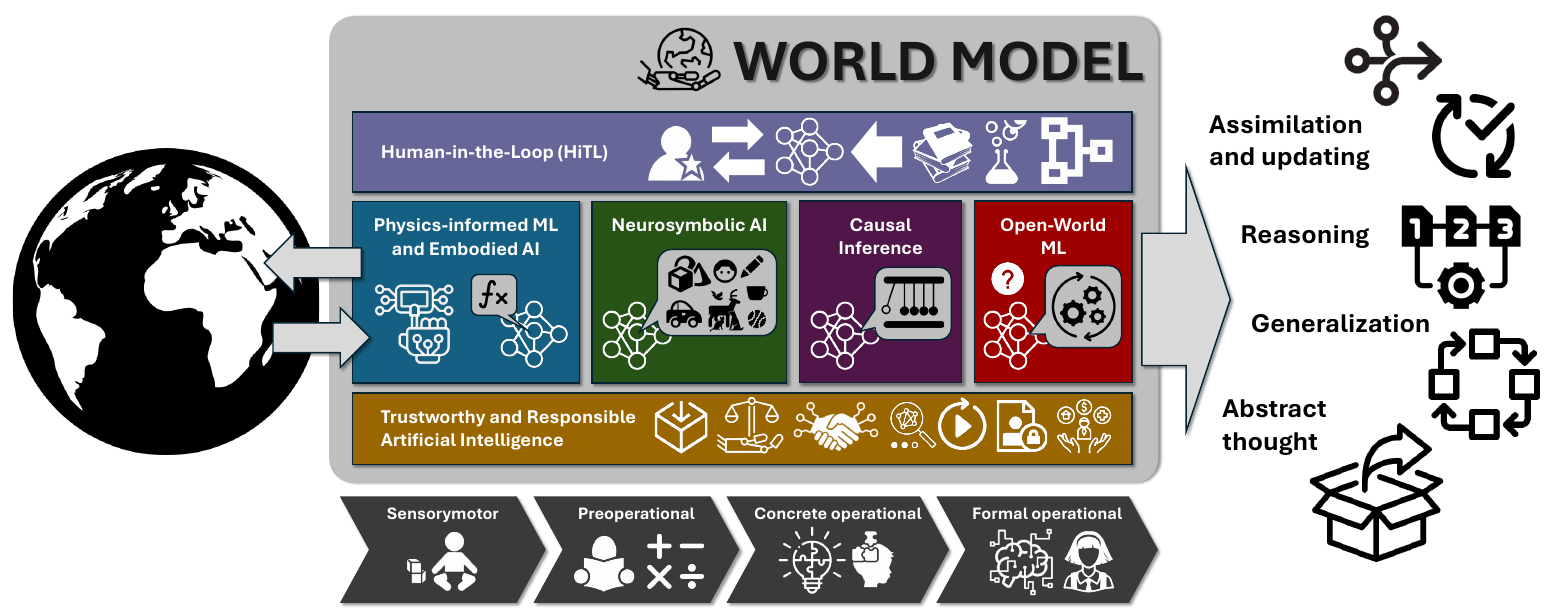
The connection among these areas is more useful than treating them as a shopping list. A system cannot safely learn from unfamiliar actions unless it can recognize uncertainty. A human correction is not useful if the representation cannot incorporate it. A learned causal relationship is not valuable to planning unless the system can apply it to candidate actions.
The authors argue that current AI needs stronger forms of these capabilities. Their argument should not be read as an experimental proof that existing AI systems cannot reason. The paper’s contribution is a proposed direction and a set of conceptual connections; it reports no new trained model, controlled trial or measured improvement from the complete combination.
A world model predicts how a situation may change. A policy chooses an action. A reward or objective defines what counts as desirable. Tools execute the action, and observations reveal what actually happened. These roles can interact without being interchangeable.
That separation helps diagnose failure. If an agent predicts that an action will succeed but reality differs, the environment model may be wrong. If it predicts the consequences correctly but chooses a harmful outcome, the objective or decision rule may be the problem. If the plan is sound but the tool fails, changing the predictive model may accomplish nothing.
Multi-step planning adds another difficulty. An inaccurate prediction becomes the input to the next prediction, allowing errors to compound. A system that looks reliable one step ahead may become unreliable over a long imagined sequence. Evaluation should therefore test the planning horizon the application will actually use.
Consider a hypothetical warehouse agent deciding where to move an item. Its observations include shelf occupancy and route availability. Its candidate action is a move; its predicted outcome includes the item’s new location and the time needed to complete it.
A small test could ask the system to predict those consequences before an existing simulator executes the move. Compare prediction with outcome. Then introduce a blocked route or a changed shelf condition and check whether the system notices the mismatch, revises its prediction and avoids repeating the same failed action.
This proposed test does not require an artificial child or an open-ended autonomous agent. It isolates one useful capability: updating an action-outcome model when the environment changes. A fixed rule or existing simulator-based planner should remain the baseline.
The evaluation should include familiar cases after each update. Otherwise, apparent adaptation to the new condition may conceal loss of previously reliable behavior. Track one-step error, multi-step error, invalid actions and how often human intervention is needed. Improvement means better decisions under those checks, not more elaborate verbal explanations.
Gymnasium provides a standard interaction pattern for an environment: reset it, take an action, and receive an observation, reward and episode-ending signals. That interface is useful for separating the simulator, the action policy and any learned predictor. It does not supply a world model or guarantee that a simulation represents a real operation.
Use an existing domain simulator when one is available. Start with a simple predictive baseline, such as the current state persisting or a known transition rule. Add a learned predictor only where that baseline has a meaningful weakness. Record predictions before executing actions so the evaluation cannot be rewritten after the outcome is known.
A minimal acceptance gate is improved prediction on held-out situations, stable behavior over the required horizon and an explicit fallback when the model encounters something unfamiliar. Keep real-world actions under the existing controls until simulation performance has been tested against actual operating conditions. No implementation was executed for this article.
The paper’s strongest practical idea is to treat interaction and correction as part of intelligence. For builders, that suggests evaluating whether an agent’s internal expectations help it act, learn from failure and recover.
The developmental analogy is a useful source of research questions, not a shortcut to engineering evidence. A narrow, measurable action-outcome test will tell a team more about readiness than calling its system a world model.
Javier Del Ser, Jesús L. Lobo, Heimo Müller and Andreas Holzinger, World Models in Artificial Intelligence: Sensing, Learning, and Reasoning Like a Child, arXiv version 1, March 19, 2025.
Test whether an agent can carry out a plan, respect dependencies and reach the actual goal.
Consider when gathering more information is preferable to acting on a promising average payoff.
Explore how agents preserve state and revise plans after a tool or earlier decision fails.