PatentGPT uses extracted knowledge to improve patent drafting. Examine its training pipeline, measured gains, mixed benchmarks and review requirements.
Select a figure to open it at full size.
A model can write fluent patent language without understanding whether the proposed mechanism works or whether the idea is new. That gap matters for teams considering AI-assisted invention workflows: better prose can accelerate a useful draft, but it can also make unsupported details harder to notice.
PatentGPT explores a way to strengthen a small language model’s technical drafting. The researchers extract relationships from existing patents, turn those relationships back into explanatory text, and combine that material with task training and human preferences.
The study reports substantial improvements on text-generation measures. Its broader patent benchmarks are mixed, and it does not establish that the generated concepts are patentable. The practical opportunity is a more specialized drafting assistant whose output remains traceable to evidence and human technical judgment.
Runtao Ren, Jian Ma and Jianxi Luo ask whether explicitly organizing domain knowledge can improve a model’s ability to generate invention concepts and patent text. Their framework, knowledge fine-tuning, changes the training material as well as the training stages.
A raw patent contains entities, relationships and drafting conventions interwoven in long text. The proposed method extracts technical concepts and their connections into a knowledge graph. It then verbalizes those connections and adds the resulting text back into model training.
The intended advantage is that the model encounters both the original description and a more explicit account of what relates to what. This is not retrieval at answer time. It is an attempt to incorporate structured domain information into the model’s learned behavior.
The original pipeline begins with patent documents and ends with a model refined using feedback.

First, extract relationships. The authors use a language model to identify concepts and connect them using categories such as “part of,” “used for” and “feature of.” Their appendix specifies entity types, descriptions and relationship records. This gives the extraction a common structure, although a structured record can still contain an extraction error.
Second, turn the graph into training text. Another prompt transforms the linked concepts into natural-language explanations. Continued training uses both these explanations and the original patent corpus. The graph is therefore an intermediate representation, not a database the final model necessarily consults while answering.
Third, teach the drafting tasks. Supervised examples train the model to respond to requests for titles, abstracts and claims. Knowing technical terminology and knowing how to produce the requested document are treated as separate learning problems.
Fourth, learn from preferences. Preferred and non-preferred responses are used to train a reward model, followed by reinforcement learning with PPO. The aim is to make the output better match the feedback provided by patent practitioners.
The experiment starts from Qwen2-1.5B-Instruct. The paper reports approximately 20,000 patents from 2021–2022, 60,000 drafting question-answer pairs and 2,000 preference interactions. The graph is derived from a subset of the patent corpus. These details matter because the method is more than a clever inference prompt: it requires domain data preparation, training and evaluation.
The patent-writing test contains 1,000 instances across eight patent-classification sections. The automatic measures compare generated text with reference text using word overlap and semantic similarity.
Within the study, adding knowledge-based pretraining before supervised fine-tuning raises BLEU-4 from 30.848 to 44.661 compared with ordinary pretraining plus supervised fine-tuning. Adding the final feedback stage raises the knowledge-based configuration to 45.360. The original chart shows this progression across several text measures.
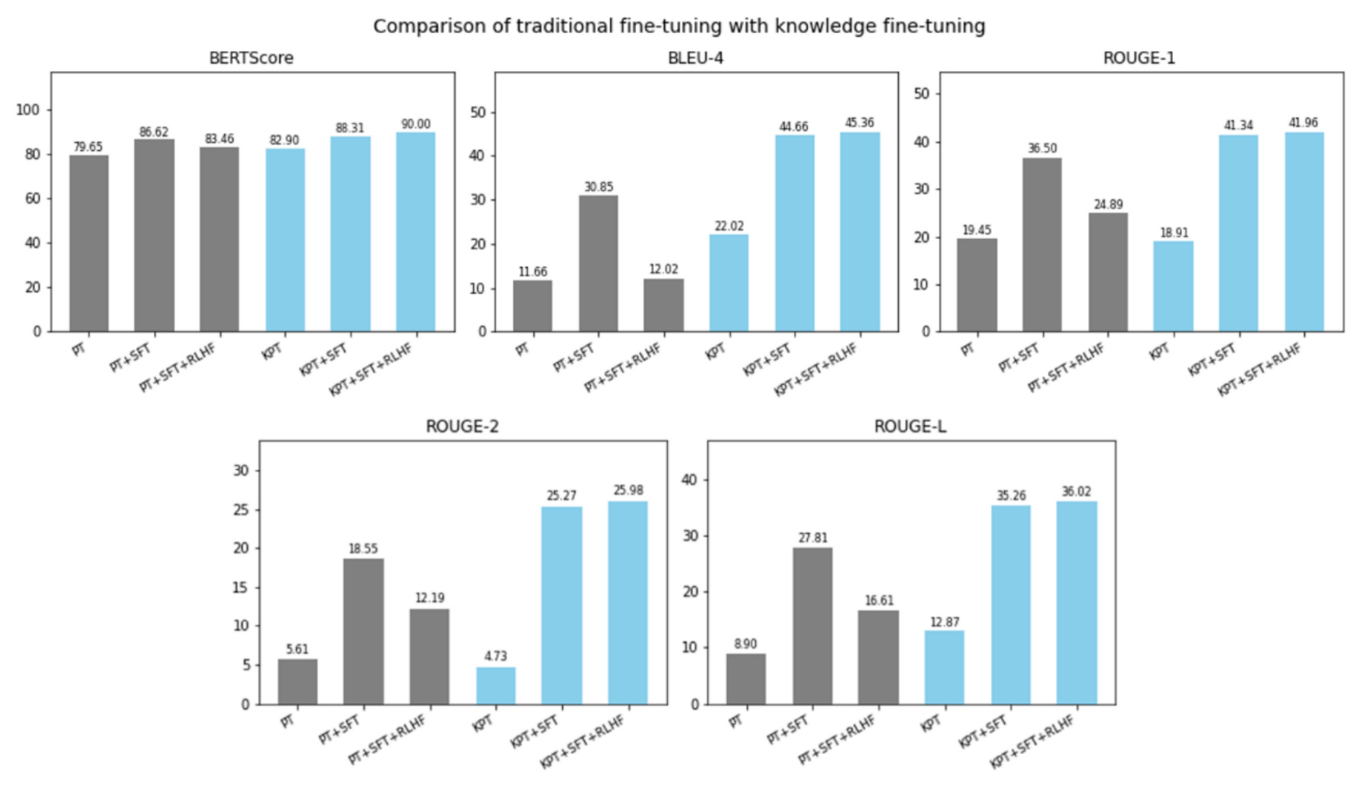
Two points are worth separating. The largest difference in this comparison comes before the final feedback step. And the ordinary pretraining sequence actually deteriorates on these measures after feedback training. A training recipe therefore needs stage-by-stage evaluation; adding a sophisticated stage does not guarantee improvement.
The scores also have a boundary. Similarity to a reference can indicate better command of terminology and format. It does not establish that a new mechanism is feasible, novel or appropriately supported. In an invention workflow, excessive similarity to existing text may itself deserve investigation.
The wider benchmarks reinforce that caution. In Table 7, PatentGPT leads the reported IP quiz score, but it does not lead the IP exam or patent-matching tasks. On patent matching, it scores 0.262 compared with 0.384 for the study’s GPT-4o baseline. Its general-knowledge score is also below the untuned Qwen2 baseline.
The evidence supports specialization on the measured drafting task. It does not support a blanket claim that the small model outperforms larger models at intellectual-property reasoning.
The worked case begins with an idea about connecting an engine and transmission through a torque converter and coordinating an electric motor with an internal-combustion engine.
The interaction proceeds through three requests: generate a title, generate an abstract from that title, then generate claims from the title and abstract. PatentGPT produces a structured description involving a torque converter, electric motor and control unit. Its claims elaborate on power distribution, operating modes and energy recovery.
That sequence illustrates the model’s ability to expand a brief idea into a document-shaped draft. It also exposes the verification burden. Features such as a planetary gear system and regenerative braking appear in the generated claims even though they were not established in the initial short request.
Those additions may be ideas worth discussing. They are not evidence that the inventor designed, tested or intended those features. A technical reviewer needs to distinguish supported details from model-proposed extensions before accepting the draft.
The paper presents the richer structure as a strength, but document completeness and invention quality are different questions. An assistant that fills every section confidently may create more checking work than one that identifies missing technical information and asks for it.
The authors also assess generated concepts using a model judge and a “rareness” measure based on distance from existing concept combinations. Those are research proxies for aspects of plausibility and unusual combinations.
The paper’s limitations explicitly acknowledge that this evaluation does not replace legal assessment of originality or patentability, and that qualitative validation by patent attorneys is missing. Its data availability statement says data will be supplied on request, which also limits immediate independent reproduction of the full experiment.
For an engineering leader, the decision is therefore about a drafting and exploration workflow. The study does not establish a reliable autonomous filing process, a grant rate or reduced professional review costs. Those outcomes require different evidence.
The paper uses LlamaFactory, which supports continued pretraining, supervised fine-tuning and preference-training approaches, including parameter-efficient methods. It is suitable for comparing training stages when a team has curated data and the capacity to evaluate them. It does not verify extracted knowledge or generated inventions.
The Language Model Evaluation Harness can provide repeatable benchmark evaluation. Pair general capability checks with a domain-specific review set so specialization does not conceal regressions. The research tools support experimentation; they do not supply the missing expert judgment.
Before reproducing the full pipeline, compare a simpler baseline: a general model supplied with the relevant source documents and a structured drafting template. If retrieval and clearer inputs solve the main problem, training may be unnecessary. If recurring domain errors remain, test whether extracted relationships address those errors specifically.
Keep each extracted relationship linked to its source passage. Sample the graph before training and check whether the verbalized explanation preserves the original relationship, direction and qualifications. Otherwise an extraction mistake can become repeated training material.
Separate training and evaluation by related patent families and time where feasible. Evaluate on new tasks whose relevant answers were not simply reformulated into the training corpus. Ask technical reviewers to label supported statements, plausible but unverified additions and incorrect details. Measure correction time and useful retained content alongside automated scores.
A useful first product can present a draft with its source support and open questions. Let reviewers accept, reject or develop the proposed extensions. That turns the vehicle example’s main risk—silent elaboration—into an explicit collaboration step.
PatentGPT is interesting as a domain-adaptation method: extracting relationships may make specialized training data more useful than raw text alone. The study gives teams a concrete pipeline and meaningful comparisons to investigate.
The strongest adoption case is a constrained drafting assistant with visible source support. We would expand it only after showing that it reduces expert correction effort while preserving technical accuracy on genuinely new cases. More polished claims, longer documents and higher similarity scores are insufficient by themselves.
Our analysis of image-generation safeguards examines a related evaluation problem: an automated proxy can help test a system without settling the underlying legal question.
Runtao Ren, Jian Ma and Jianxi Luo, Large language model for patent concept generation. Advanced Engineering Informatics 65 (2025), article 103301, DOI. This review uses arXiv:2409.00092v3, uploaded 8 April 2025, containing the published article.
Explore why indirect descriptions can bypass name-based image safeguards.
See why a model that ranks answers well may still provide a poor training signal.