A practical reading of AI-agent architecture: perception, memory, tools and outcome checks. Learn when a stateful workflow needs more autonomy.
Select a figure to open it at full size.
An assistant becomes operationally consequential when it can change something outside the conversation: update a ticket, call a service, schedule work or trigger another process. At that point, answer quality is only one part of reliability.
AI Agents: Evolution, Architecture, and Real-World Applications provides a conceptual account of the components surrounding that behavior. It is a review and architectural synthesis, not a new controlled experiment demonstrating a productivity gain.
Its practical use is as a design lens. Before expanding an agent’s authority, identify what it observes, what it remembers, how it selects an action and how the system knows that action actually worked.
The paper organizes an agent around perception, knowledge representation, reasoning, action, memory and adaptation. These categories describe responsibilities. They do not require six separate models or a multi-agent framework.
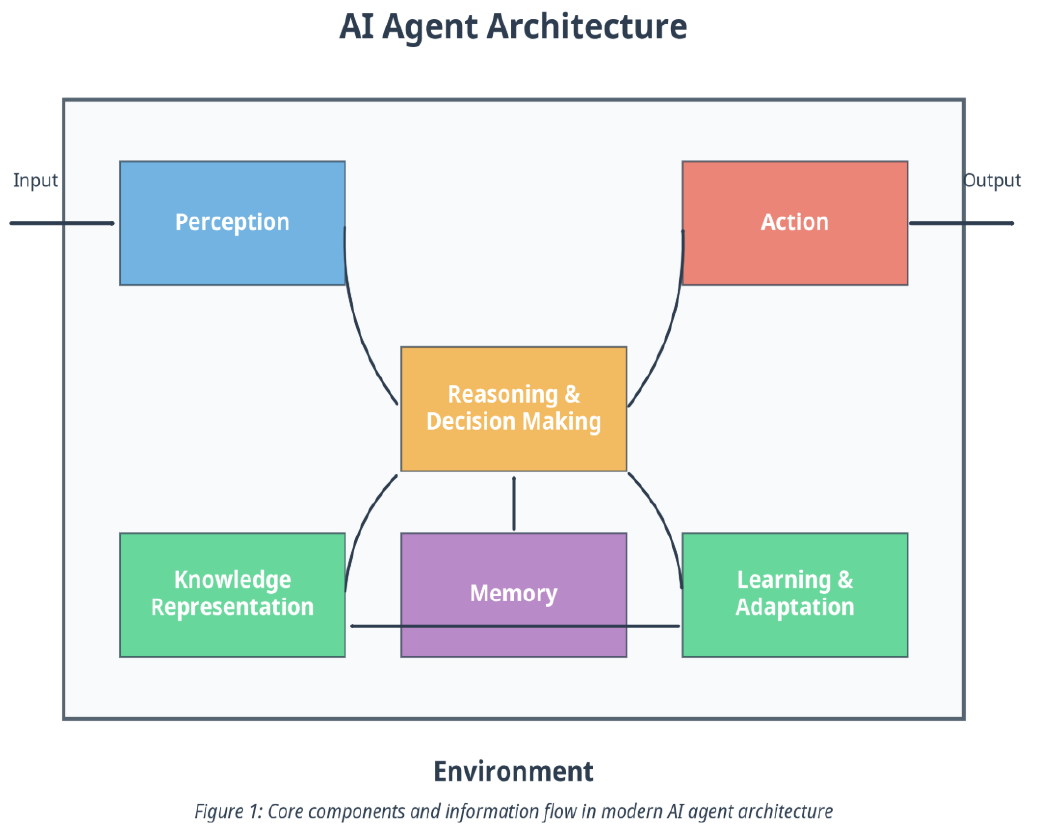
Perception turns incoming information into something the system can use. In a support workflow, that might be a ticket’s text, attachments and current status. Knowledge representation supplies structured context, such as product identifiers, account permissions or documented procedures.
Reasoning and decision-making select a next step. Action carries it out through an external interface. These stages must remain distinguishable: producing a well-formed plan is not proof that a service accepted the request or that the intended state changed.
Memory preserves information needed across steps or sessions. A stored conversation, a task record and the text inside the current model prompt are related but different mechanisms. Saving a successful action in a database does not automatically retrain the language model’s weights.
Finally, adaptation concerns how behavior changes with feedback. That could mean updating a policy, modifying retrieved context or revising a workflow. A team should specify which one it intends rather than promising that the system will simply “learn” from use.
The paper discusses IT helpdesk work as an application, including handling tickets and maintaining context. The following is a way to turn that proposed application into an inspectable workflow; it is not a measured deployment reported by the paper.
Suppose an employee reports that an application is unavailable. The intake step identifies the application and checks whether the employee supplied enough information. The system retrieves the approved troubleshooting procedure and the current ticket state.
The model can propose a next diagnostic step or draft a response. The workflow then checks whether that step is permitted and whether it requires approval. If an external action is allowed, the tool executes it and returns a result that the workflow records.
The final check asks whether the intended condition changed. A successful API response may only mean that a request was accepted, not that the employee can use the application again. The agent should not close the ticket merely because it reached the end of its plan.
Persistent state also matters during interruption. If the workflow resumes after a timeout, it must know whether the action already occurred. Otherwise, a retry can create a duplicate request or repeat a change. This is a property of the surrounding application, not something to leave to conversational memory alone.
The example explains why an agent project can fail despite good model answers: the missing capability may be reliable state management, permission checking or outcome verification.
The paper’s evaluation discussion spans capability, efficiency, robustness and deployment considerations. A useful operational test needs these to refer to a complete task rather than a polished individual response.
For the helpdesk example, compare the agent-assisted workflow with the existing process on the same cases. Record whether the correct final state was reached, how much human correction was needed, how long the task took and what it cost. Include interrupted tasks, missing information and tool errors.
Keep quality and cost visible together. A cheaper system with worse outcomes and a more expensive system with better outcomes may both remain candidates until the team decides how much the quality difference is worth. Reducing the comparison to one score can conceal that tradeoff.
The paper proposes staged evaluation: examine components, integrate them, test in controlled conditions and then assess behavior in the field with continuing monitoring. The practical implication is to narrow authority during early stages, where failures are easier to diagnose and reverse.
No original benchmark in this review establishes that its architecture beats a simpler workflow. That comparison belongs in the implementation plan.
If the task has a small set of known states and rules, ordinary application code may already express the process clearly. A model can be limited to the ambiguous part, such as interpreting a free-text request or drafting a response.
More autonomy becomes attractive when the next useful step genuinely depends on information discovered during execution. Even then, the tools, permitted actions and stopping conditions should be explicit. Flexibility in choosing a step does not require unlimited authority to perform it.
This distinction also appears in the research on LLM-supported team decisions: collecting preferences and proposing options can be useful while the final commitment remains with people.
An existing database, task queue and state machine can implement the helpdesk sequence. Store the task’s status and action outcomes explicitly, and attach a stable identifier to operations that may be retried. Begin with recommendations and draft responses before enabling consequential tool calls.
LangGraph is an option when the application needs stateful orchestration, persistence and human-in-the-loop steps. Its role is managing the workflow around model calls. It does not decide which actions your organization should authorize or prove that a completed run achieved the correct outcome.
Start with a small, representative case set and a conventional baseline. Add failure cases deliberately: unavailable tools, contradictory records and interrupted execution. Expand authority only when the complete workflow meets the agreed outcome and recovery criteria, with an escalation route when it cannot proceed.
This paper is useful as an architectural checklist, provided its conceptual scope stays clear. It helps teams locate the responsibilities that sit outside the model and therefore outside a simple prompt-quality evaluation.
The strongest first agent is often a narrow workflow with explicit state and a well-defined action boundary. Broader autonomy should follow evidence that the system can complete, verify and recover from real tasks—not the fluency of its plan.
AI Agents: Evolution, Architecture, and Real-World Applications, Naveen Krishnan. Version 1, March 16, 2025. This article discusses its conceptual architecture and evaluation guidance, including original Figure 1; it does not treat the review as an original deployment experiment.
Understand how tools, feedback and stopping rules change a chatbot into an agent.
Explore coordination, ownership and recovery when several agents contribute to one workflow.
Extend safety testing to the memory, tools and actions surrounding an AI model.