Understand ODI’s conceptual framework and turn agent coordination into explicit state, approval, recovery and evaluation requirements.
Select a figure to open it at full size.
An inventory agent can recommend buying more stock while a finance agent recommends conserving cash. Both can be reasonable within their own tasks. The business still needs one decision, an accountable owner and a way to recover if the order is wrong.
That coordination problem is the useful starting point for Orchestrated Distributed Intelligence, a framework proposed by Krti Tallam. Its central argument is that useful enterprise AI depends on the system connecting specialist capabilities, human judgment and operational feedback. Improving an individual model does not resolve conflicts between those parts.
For engineering and product leaders, this is an architecture question: what should coordinate the work, what may it change, and when must it stop? The paper offers a conceptual answer. It does not establish that this architecture improves productivity by a particular percentage or that every workflow needs multiple agents.
Tallam develops ODI from systems thinking, multi-agent literature and discussion of organizational adoption. There is no controlled comparison of an ODI deployment with a single-agent baseline. The contribution is a way to organize the problem and a research agenda for testing it.
The paper’s central framework connects three things that teams often evaluate separately: the specialist tools doing the work, the coordination layer deciding how their outputs fit together, and the people who determine acceptable outcomes. Feedback should reach all three. A technically successful tool call can still produce an operationally unacceptable result.
The author describes an evolution from recording information, through automating steps and introducing agents, toward an integrated “system of action.” The diagram below shows that proposal. It is an architectural argument, not a maturity scale validated across companies.
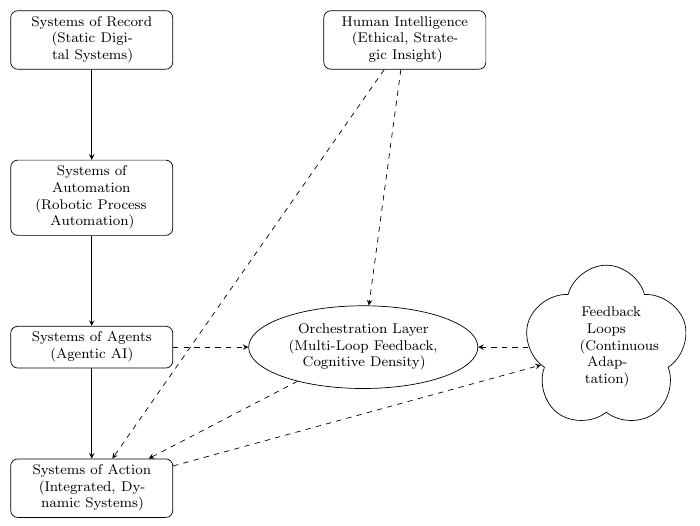
Notice that the human component connects to the system rather than appearing only at the start. Setting a goal once is insufficient if conditions change during execution. Equally, the feedback connection matters only if the organization defines which observations may change the plan and which require someone to review it.
In practice, the diagram should sit above reliable records, not replace them. Orders, approvals and inventory still need authoritative stored state. The proposed move toward action adds a coordination responsibility to that foundation.
The paper uses cognitive density to describe the concentration of processing capability, context and interpretation within the system. This is a qualitative concept here, not a measured performance score. A useful engineering translation is whether the decision process has the relevant information and can use it correctly. Adding agents that repeat the same incomplete context does not satisfy that need.
Its second idea, multi-loop flow, means feedback at different timescales. A failed API call might require an immediate retry or escalation. A week of repeated human overrides might require changing a workflow. A quarter of poor outcomes might invalidate the business objective. Treating all three as “the agent should learn” leaves the actual correction mechanism undefined.
The third idea is tool dependency: specialist capabilities must work through compatible interfaces and coordinated responsibilities. Forecasting demand, checking a budget and placing an order are different operations. Their outputs need a shared meaning before one can safely depend on another. A confident forecast is not spending authorization.
These concepts are developed in Section 3.3. Their practical contribution is to make integration part of the design problem. They do not provide a ready-made scheduler, state model or conflict-resolution algorithm. Those remain implementation choices.
The paper illustrates its argument with a manufacturing progression in Section 5.3.
First, a firm records inventory and schedules. Automation then handles routine transactions such as order processing. Agentic capabilities add predictions, including potential equipment failures. Finally, an integrated system coordinates production schedules with those predictions and changing demand.
The meaningful transition is between producing a warning and coordinating a response. Predicting a failure does not establish whether to stop a machine now, move an order to another line or delay maintenance. That decision depends on information and authority outside the prediction model.
The paper describes the progression and attaches an efficiency claim, but it does not supply an ODI trial, participant details or a controlled evaluation supporting that gain. The example is useful for understanding the proposed architecture; it is insufficient for forecasting a return on investment.
This distinction changes the adoption decision. A team can use ODI to expose missing responsibilities in a design review. It still needs its own evidence that the resulting workflow performs better than a simpler alternative.
Consider a procurement workflow that responds to a forecasted shortage. This is a practical extension of the paper’s argument.
The demand component supplies a forecast with its date, inputs and uncertainty. The inventory component supplies available stock and outstanding orders. The finance component supplies the remaining budget. A coordinator combines them into a proposed purchase. Before any external order is placed, the system checks authorization and asks the responsible buyer to resolve exceptions.
Several boundaries need to be explicit:
The lesson from ODI is the need to coordinate these dependencies. The particular contract above is an implementation recommendation, not a specification provided or tested by the paper.
For another view of where model decisions belong inside an operational pipeline, our traffic incident management analysis examines a system that first converts observations into structured evidence.
Start by drawing the allowed states of one workflow: evidence collected, proposal prepared, awaiting approval, action committed, outcome checked, or escalated. Put a model only where interpreting unstructured information adds value. A queue, database and existing application code can be enough when the sequence is short and predictable.
LangGraph is an option when the workflow needs explicit model-driven branches and pauses for external input. Its interrupt mechanism saves state through a checkpointer and resumes with an external response. Use a durable checkpointer and stable case identifier. Importantly, a resumed node restarts from its beginning, so operations before the pause must be safe to repeat. An approval pause does not itself establish that the approver has permission.
Temporal is an alternative for organizing long-running application workflows around durable execution. Its workflow documentation is relevant when a process must survive interruptions while coordinating activities over time. It does not determine whether an AI recommendation is correct; that remains a separate evaluation and authorization responsibility.
Choose a coordinator based on the recovery and state-management problem you actually have. Introducing two orchestration frameworks before one workflow works makes failure ownership harder to reason about. Neither tool is an implementation evaluated in the ODI paper.
The paper calls for simulations, pilots and longitudinal evaluation in its research roadmap. A useful first pilot compares three approaches on the same archived cases: the current process, a fixed workflow with one model, and a coordinated specialist workflow.
Have domain reviewers assess the final decision without seeing which approach produced it. Record missing evidence, inappropriate commitments, human rework, completion time and total operating cost. Include failures: stale stock data, conflicting budget instructions, an unavailable service and an ambiguous purchase response.
Those cases test different promises. Specialist coordination may improve the decision while making the process too slow. It may produce better explanations without reducing human rework. It may succeed on ordinary cases but duplicate a transaction after a timeout. A single aggregate “agent accuracy” figure would hide these distinctions.
Set acceptance conditions before examining results. If specialist agents do not improve an outcome that matters enough to justify their added cost and failure modes, keep the simpler workflow. If a human must routinely reconstruct the entire case to approve it, improve the evidence presentation before increasing autonomy.
ODI is most useful as a challenge to narrow agent demos: show the complete decision process, including its dependencies, authority and recovery behavior. It is much less useful as a promise that orchestrating more models will create an intelligent organization.
The first investment should be in making one workflow observable and accountable. Expand the number of agents only when specialization improves a measured outcome. The evidence that would change our recommendation is straightforward: a coordinated system that repeatedly beats the simpler baseline on meaningful cases, including failures, at an acceptable operating cost.
Krti Tallam, From Autonomous Agents to Integrated Systems, A New Paradigm: Orchestrated Distributed Intelligence. arXiv:2503.13754v2, submitted 19 March 2025; the PDF carries an internal date of 20 March 2025. This article examines the conceptual framework, not a validated deployment result.
Compare agent-team structures and the point where adding agents stops helping.
Explore how agents preserve state and revise plans after a tool or earlier decision fails.
Design permissions, checkpoints and recovery before giving an agent more autonomy.